Restoration as Innovation
Seeing the past through a new lens
Long before pixels and processors, quiet alchemy. In dimly lit dark- rooms, early photographers coaxed images into being, softening shadows, heightening contrast, shaping reality with practiced hands. Even then, the medium was not simply about capturing truth but interpreting it. And as with any new technology, it arrived with hesitation. Some embraced it; others distrusted it. That push and pull between innovation and authenticity has followed photography ever since.
For Bill Price, that tension feels less like a conflict and more like a continuum. His life’s work traces the arc of technological evolution, from the earliest days of digital networking to today’s rapidly advancing tools for image restoration. In many ways, his current passion for colorizing and restoring historical photographs is not a departure from his former career but an extension of it.

Price grew up in North Florida, with roots in both Monticello and Tallahassee. His love of the past began early. Born in 1956, he describes himself as a child drawn to “old things,” a kid who found meaning in the stories of people from another time. He went on to study anthropology, and that pull toward the past remained constant.
It evolved alongside an interest in technology. After serving in the Air Force, Price built a career in telecommunications, helping shape infrastructure that would support the modern internet. In the 1980s, he worked as a Centel executive in Tallahassee, helping implement one of the nation’s earliest Metropolitan Area Networks. He later helped launch BellSouth’s Internet Division from Atlanta, an effort that placed him squarely within the emerging digital frontier.

Children Playing Live Oak Plantation 1899
Looking back, the connection between that work and what he does now seems almost inevitable. “I was always curious and open to trying new things. So in my career, I did a lot of that, using technology,” Price explains. Only upon reflection does the throughline fully come into focus. His lifelong curiosity and comfort with emerging tools have naturally extended into this new, more creative chapter.
That same openness eventually led him into photo restoration in a personal way. His wife, an accomplished photographer, introduced him to Adobe Photoshop. At the same time, he began digitizing thousands of family photographs, traveling with a scanner to preserve images from relatives across the country.
What began as preservation soon became transformation. As new software emerged, Price explored its possibilities. “I started tinkering around, seeing how you could make improvements to photos,” he says. “I was just playing around as an amateur.”

College Avenue Looking East C 1930s
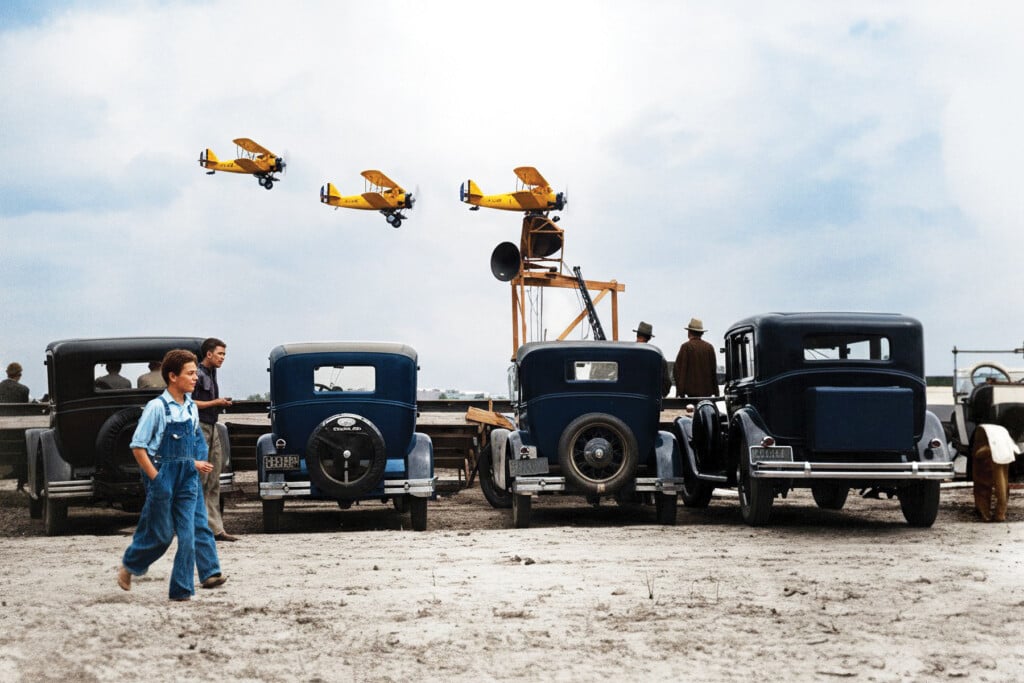
Over time, that experimentation grew into expertise. Today, Price has restored and colorized thousands of images from public archives and databases. His process is both technical and intuitive, shaped by his evolving relationship with new tools.
At first, he was skeptical of artificial intelligence, dismissing it as “software marketing.” But after experimenting with different platforms, he began to see its potential. What struck him most was how powerful they could be with the right input and how even photographs in “the most incredibly horrible shape” could be transformed with carefully crafted instructions.

Portrait of an unknown young woman, Tallahassee, c. 1880s–1890s
He always begins with Photoshop. “I adjust things like contrast, remove scratches and dots,” before moving to AI programs. Often, he runs multiple versions at once. “I typically have five different programs open. Using the same script and the same photo, the different programs will yield five different results.”
Price is clear about his intentions. “My sole goal is to improve the photo,” he says. In an era when AI-generated images can blur the line between real and imagined, he draws a firm boundary. “I would never create something out of thin air. That’s not me. That’s not what I do.”Price’s work is grounded in respect for the original image and the people in it. That sensitivity resonates with others. Price shares his work on his Facebook page, where viewers often recognize long-lost relatives or familiar places. A frequent comment is that he has “brought the images to life.”

Florida State College football team, 1902
In recent years, Price has turned his attention to Florida’s visual history, including thousands of images from the Tallahassee region. As the United States celebrates its 250th anniversary, his work offers a reminder that national history is built from local stories.
In retirement, Price has found a way to merge lifelong interests in history and technology into something both personal and communal. It is a full-circle story, but one that also points forward. The same instinct that once drove him to help build the infrastructure of a connected world now guides his use of emerging technologies to reframe what came before. By applying the most current tools to the oldest images, Price reveals the past not as something distant or fixed, but as something still evolving and newly visible through the lens of innovation.