Colorado’s Reborn Frontier
Dunton Hot Springs revives a long-abandoned mining town as a design-rich, geothermal retreat steeped in history and wild beauty
Travelers flock to the Colorado Rockies for skiing, hiking, and crisp alpine air, but deep in the San Juan Mountains lies a different Colorado altogether. Hidden between stands of blue spruce, ponderosa, conifers, and aspen groves, steaming mineral pools emerge from the earth, and a chapter of the Wild West remains preserved in full. Together, they shape one of the country’s most intriguing luxury retreats: Dunton Hot Springs.
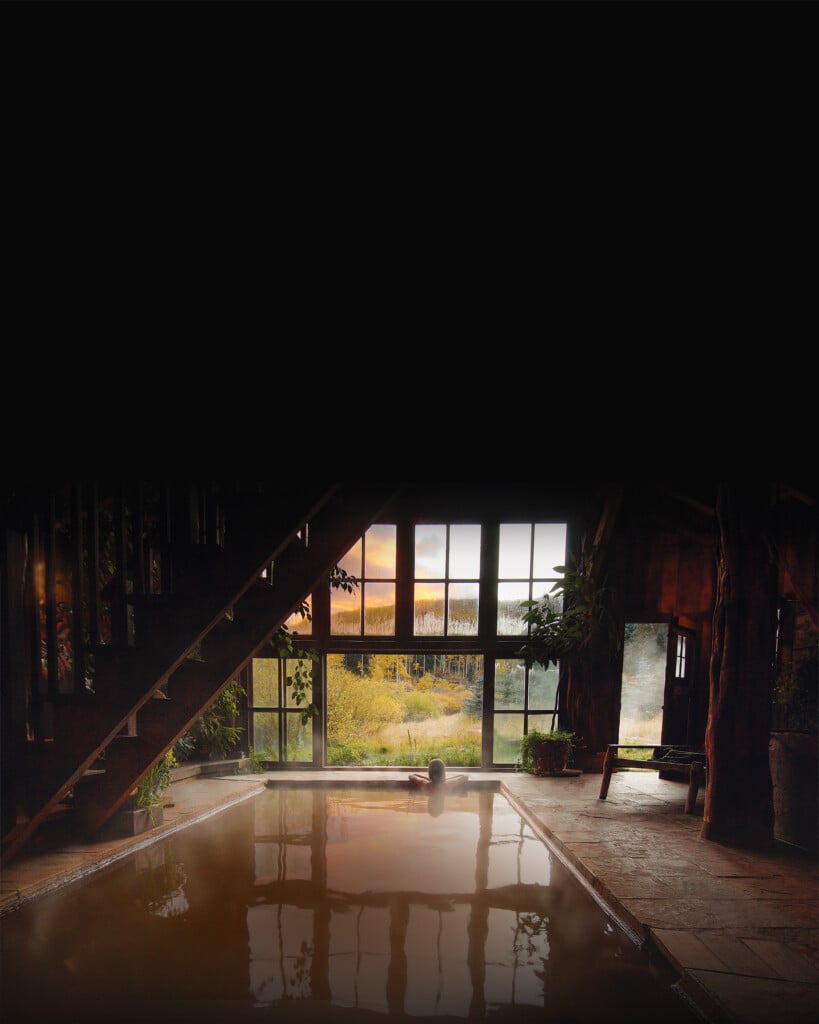
Arriving at Dunton Hot Springs feels less like checking into a hotel and more like stepping onto the set of a meticulously crafted period film. The Relais & Châteaux property comprises the footprint of an 1885 mining settlement, later abandoned. Since purchasing the entirety of this ghost town in the 1990s, German investor Christoph Henkel has spent decades restoring, upcycling, and resurrecting this American frontier village with salvageable elements supplemented by other Colorado relics. At the heart of his passion project are a series of hot springs and the revival of the town’s original bathhouse, where miners once soaked in calcium bicarbonate pools enriched with iron, manganese, and a hint of lithium.

PHOTO COURTESY OF DUNTON HOT SPRINGS
Just as central to Dunton’s revival is the saloon and dance hall, refreshed as recently as 2024. Here, an open kitchen showcases the property’s Relais & Châteaux culinary ethos, while the bar recalls the Old West. The bar top is original, etched with Butch Cassidy’s carved signature from his post–bank robbery wanderings and accompanied by scrawls attributed to the Sundance Kid. The vintage cash register hails from a nearby town and dates to the early 1900s. Dramatic wagon wheel fixtures hang above the communal dining table, paired with olive-toned director’s chairs. Custom drapery, camel-colored leather banquettes, patterned and solid upholstery, and a mix of printed ceramic and metallic ceiling panels form an aesthetic vocabulary worthy of a design book. One nook holds the original gilded Pony Express station from Colorado Springs, another a century-old one-slate pool table. Add in the owners’ personal art and taxidermy pieces, and the space becomes part saloon, part gallery, part living archive.
From this “town square,” footpaths lead to 14 log cabins, many constructed by miners in the late-nineteenth century. Every cottage has its own story, preserved in artifacts, furniture, and art, and every window frames meadows or mountain ridgelines. Some cabins reflect frontier history, like the Dunton Store, which still occupies its original 1887 perch. Others feel like contemporary Western hideaways. I stayed in Major Ross, a cozy cabin warmed by a wood-burning fireplace and outfitted with a quilted king bed flanked by denim and leather textures. Three-dimensional prints echo the region’s wildlife heritage, and vintage photographs mingle with items from the owners’ collection. The small mudroom at the entrance is a post-hike necessity, and a penny-tiled bathroom features a barrel soaking tub and an outdoor shower.

PHOTO COURTESY OF DUNTON HOT SPRINGS
In all cabins, thick robes hang in the closet, used principally as cover-ups for the quick walk (in any season) to the transformed bathhouse. This historic landmark rises as a steam-filled refuge where floor-to-ceiling glass windows interject original woodwork, doling out vistas of aspen groves quivering in the breeze. A staircase leads to a loft above the water, while a second outdoor spring and a cold-plunge pool offer alternating hits of heat and chill.
But the springs aren’t Dunton’s only exceptional water feature. Near the end of town lies a nature trail that leads to a waterfall—a stunning reveal in summer and an ice-climbing site come winter. Nearby streams support fly-fishing, and Dunton sits at the center of a playground for seasonal adventure, including rafting. Year-round, guests are invited to hike surrounding trails and join complimentary group yoga and movement sessions, Dunton history tours, and Orvis Fly-Fishing 101 (more rigorous outings come with a fee). A day in the San Juans may involve snowshoeing or cross-country skiing in winter, or hiking, mountain biking, rock climbing, or horseback riding in summer.
Though outdoor exploration is encouraged, the true Dunton cadence commands sitting back and paying attention to the land, the history, and the pleasure of slow living. Cabin porches provide front-row seats to daily cattle crossings. The saloon’s craft table is always stocked with supplies for flower pressing, beadwork, leather stamping, or candle making. The loft library offers quiet refuge, complete with rare books and whiskey. Evenings close with a bonfire where guests roast s’mores beneath starry Colorado skies. The spa adds another layer of calm with treatments featuring the Susanne Kaufmann line, known for products rooted in high-alpine botanicals.

PHOTO COURTESY OF DUNTON HOT SPRINGS
Meals are included in the nightly rate, and the culinary experience is a highlight. Sustainability and seasonality guide the menu, which changes daily and taps into the region’s farms. Colorado makes frequent appearances on the drinks list as well, from beers brewed in Durango and Telluride to local gin, whiskey, and agave spirits, plus wines from Sutcliffe Vineyards in Cortez. Lunch is usually served family style. Dinners shift to individual courses after a 5:30 p.m. social hour, when guests gather for a signature cocktail and appetizers. One evening, I sipped a Colorado Bourbon Peach Old-Fashioned while snacking on potato chips with Rocky Mountain trout dip. Dinner unfolded with comforting soups, local beef, and a finale at the tea station, which displays a dozen varieties in beautiful ceramics. The open kitchen feels almost aspirational in its organization, with pressed linens, custom dishware, and the kind of meticulous pantry Martha Stewart could get behind. It is no surprise Dunton was previously named among “The Best Hotels for Food Lovers in America” by Bon Appétit.
For all its historic reverence and natural beauty, much of Dunton’s charm lies in the invitation to play along. Guests arrive in cowboy hats and boots, suede vests, flannels, or whatever helps them slip into a frontier mindset. The cabins, the springs, the saloon, and the surrounding wilderness make it unusually easy to imagine life in this valley 130 years ago, offering endless fodder for journaling, quiet thought, a bit of role-play, and, of course, blowing up social media. Many places inspire daydreaming, but Dunton gives those dreams a veritable setting—a chance to live out your own Wild West story without ever leaving the comforts of the present, surrounded by mountains, warmed by geothermal pools, and grounded in revived history.

PHOTO COURTESY OF DUNTON HOT SPRINGS
Embarking on this immersive, magical journey back in time requires intention and multiple flight connections. The drive to Dunton takes about three hours from Montrose and roughly two from Durango, even less from Cortez or Telluride. From all gateways, expect routes that wind through breathtaking alpine scenery, with enough lookout points to tempt even the most disciplined drivers. Eventually, the pavement gives way to dirt roads for the final 45 minutes: a rugged, anticipation-building stretch that heightens the moment before the ghost town appears and you vanish into its fantasy vortex. (duntondestinations.com/hot-springs)