Turning Back the Clock
Analog hobbies refresh a new generation
In the 2026 “Director’s Issue” of W magazine, Timothee Chalamet portrays “Shend,” a New York local and competitive Yu-Gi-Oh! player. The shots of Chalamet actually playing Yu-Gi-Oh!, set in a typical card shop brimming with wares, are palpably richer with positive energy than the rest of the editorial: The lighting is relaxed, and the table is crowded with all kinds of faces. Conversation, competition, intrigue, pride, joy: It’s all in the heart of the cards, as a Yu-Gi-Oh! player would say. It’s hard not to be sold on the experience.
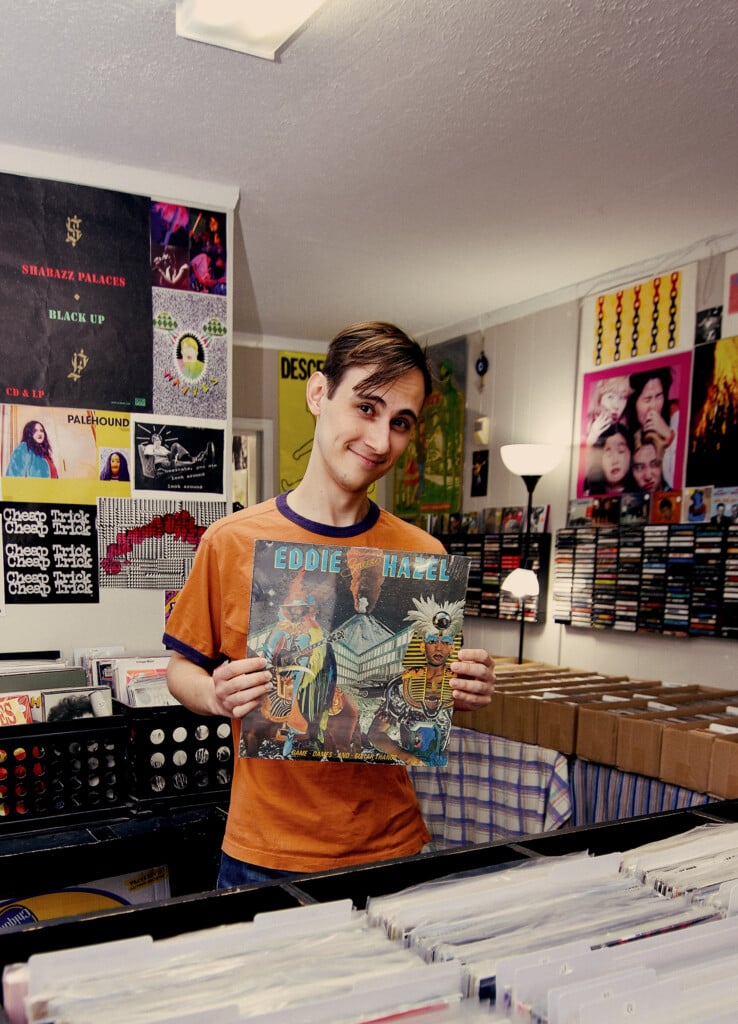
Whether you’re reading W, walking through Target, or scrolling TikTok, you may have also noticed that analog hobbies are back in force. After all, “The underground typically drives the mainstream,” according to Paul Chapman of Real Cool Time Records, a shop he’s operated with partner Matt Sampson since 2022. While CD-store veteran Chapman has watched this resurgence bloom over the past 25 years, the last six have been particularly fruitful in bringing a new generation of customers to analog hobbies.
“Toys from the ’80s, Tamagotchi pets, Pokémon,” Chapman says of pandemic-era collecting, “you can collect it all. If it’s something cool, people were bored at home, so everything went crazy.”
The collections that Real Cool Time Records (RCTR) is best equipped to cater to, though, are those of the sonic variety: vinyl, cassettes, and CDs, which have all amassed legions of new devotees. Listening to and collecting vinyl found “real momentum around 2010,” according to Chapman, and reentered the mainstream in the mid-teens while affordable turntables landed in retailers like Urban Outfitters. Independent and pre-owned retailers were a catalyst to this resurgence and reap the benefits as the industry continues to grow.
“Your big moments are Father’s Day, Mother’s Day, and Christmas,” Chapman says. “Customers come in saying, ‘I got a record player. My kid got me a record player.’ Now, you’ve got parents who got into records because their kids got into records, and so they started collecting again. And now you’ve got grandparents who say, ‘Well, my kid and my grandkid are collecting it, so I wish I hadn’t gotten rid of all my records.’”

Photo by Lindsey Masterson
Today, the mainstream is responding. Artists like BTS are a prime example of the demand for new-wave specialty vinyl: The seven multicolored pressings—one color corresponding to each member of the group—of their 2026 album Arirang sold out almost immediately on web platforms. Enormous batches of vinyl like this historically delayed production for smaller artists; however, the sometimes years-long “backlog has loosened up,” Chapman says, as “several boutique [pressing] plants have opened up in America,” and the demand for more pressing machinery is fulfilled.
Chapman adds that young music collectors are a price-sensitive group: “Younger generations like [cassette] tapes and CDs, and part of it is that they like the prices better.” When considering a rare ’90s record, for instance, “You can get the CD for eight bucks. You might pay $30 for a cassette. You might pay $300 for the record.”
For such an investment, these buyers generally prefer to go home with an armload. Chapman says, “They’re the ones that come up [to the register] with a record, a CD, a tape, a book, a comic book, and a DVD. They buy it all.
“You’ll hear people say, ‘I just love physical media.’”
All of the pre-owned media these consumers collect stays out of landfills, too, Chapman notes, and avoids the high energy costs of streaming media online.
Like most millennials caught between the poles of self-taught minimalism and pleasingly tactile excess, I’ve contended with how to manage my own accrued physical memorabilia. For instance, mere months after my brother and I donated the majority of our early aughts Pokémon card vault, I found myself rifling through stacks of pre-owned cards with him at CardsHQ in Atlanta; I even took home a neat handful of my favorite monsters. The shop was packed with young people surely feeling, as I did, a magnetic pull back to the happiness of surrounding oneself with physical tokens of beloved media.

Photo by Lindsey Masterson
One doesn’t need a trip to a big city,though, to see the impact of local game stores. Tara Angel’s Magic, a Tallahassee-local card and board game store led by Tara Hewitt, is one of the businesses at the forefront.
While the store has served as a welcome gathering place since 2011, “Since the pandemic we have seen a surge in tabletop gaming, especially with Magic [the Gathering],” Hewitt says. “But across the board, the industry has grown. People want face-to-face connections over endless scrolling. It’s rewarding to find a new group of friends. The third-place concept is real.”
The customers embracing this return to face-to-face connection are both “young and old,” Hewitt says. She credits media like Stranger Things and the star-studded Dungeons & Dragons podcast Critical Role for helping create new lovers of local game stores.
“‘Nerdy’ is the new ‘cool,’” Hewitt says. And Tara Angel’s Magic is “an experience … You can browse for an hour and still see new things.”
Within that hour, what customers find is a niche. Whether it’s card collecting, figure painting, or a new tabletop game, there’s a certain joy inherent in browsing face-to-face and taking home what pulls you in.
“Maybe it’s a little bit mystical,” says Paul Chapman, “when you hold something in your hand. When you walk into a record store, there’s that musty, syrupy smell, or when you walk into a bookstore, you can smell that fresh paper. I think people need those things.
“I think we’ve reached [an understanding that] if you want to have excess, that’s fine. If you want to have minimalism, that’s fine too. But like, it’s okay to like things. It’s okay to appreciate them.”
It’s hard not to like—even love—that we’re entering a new era of analog joy.