The Wild Side
Five Essays on North Florida Lore
The more you get to know our region, the more you fall in love with its unconventional bits: the quirks, the local legends, the hidden places that—
once discovered—make you wonder why no one told you about this sooner. Every story feels like a chip in a mosaic. I was lucky enough to hear from five writers with their own Tallahassee history about some particularly eye-catching glints in this picture—places, moments, and inside jokes that speak to our home’s weird and wonderful spirit.
The Lure of Lichgate
By Rebecca Padgett Frett
Potions brewed in a bird bath. Fairy homes fashioned of toadstools, tree bark, and wildflowers. My childhood was spent communing with the magical in the forest of my parents’ backyard.
Somewhere along the way of cellphones and emails and loneliness, I lost touch with the hold the mystic had on me. Recently graduated and with my first adult job, my evenings and weekends were spent aimlessly wondering and wandering. As I’ve done throughout my life, I took to seeking solace outdoors. In researching parks and trails, I came across Lichgate on High Road.
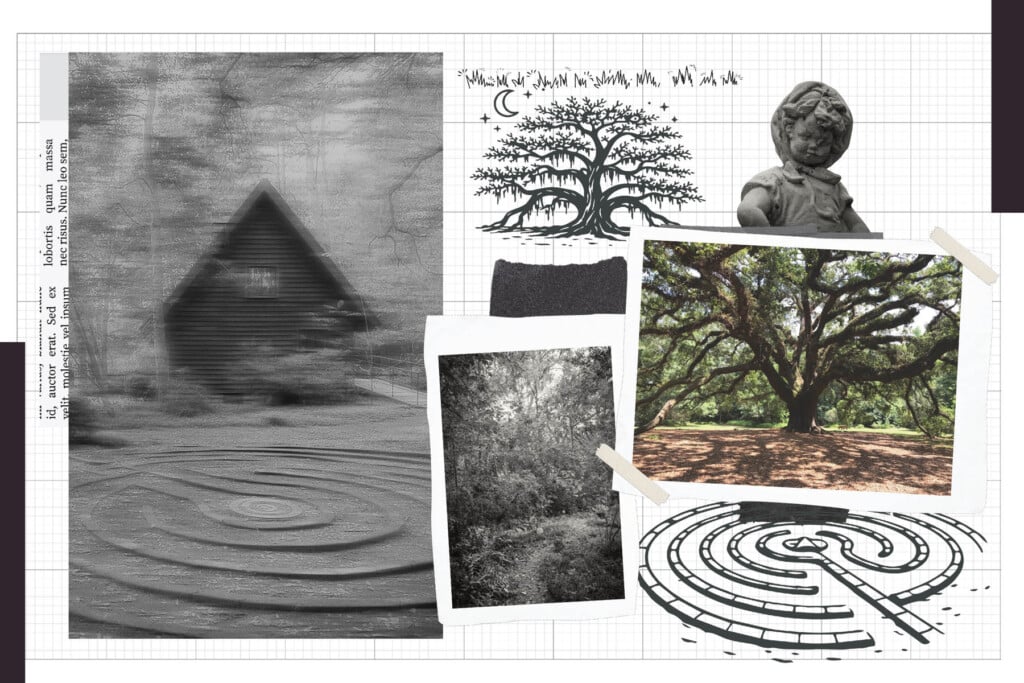
The majestic ancient oak lured me first, as it does many. Like the moss spanning the tree branches, the grounds were draped in lore.
Idyllic, ethereal, warm, and quiet in a way that places brimming with magic often are, it was difficult to believe a busy road sat just beyond the trees.
The garden was alluring; a younger version of myself would have spied pixies flitting through the leaves, a gnome in the crevice of a tree, a witch foraging for her apothecary.
What I found myself most compelled by were the manmade, in this case, woman-made aspects. The lichgate, the labyrinth, the cottage. I became completely enraptured by the story of Dr. Laura Pauline Jepsen, the woman who saw a scenic expanse of land, envisioned on it the life she wanted to cultivate, and brought it to fruition. Further, she was a woman of words and an English professor, something I one day aspired to be.
At Lichgate, a portal to the world of spirits didn’t open to me. An enchantress didn’t captivate me with her swirling crystal ball and cosmic prophecies. What I did find was that the reality of a woman harnessing her power and building the life she wants is its own form of magic.

Collage by Lindsey Masterson
All Hail the Mighty Magnet
Kathleen Laufenberg, a former MagLab employee and winner of the 2022 Montana Humor Award in Fiction
Nestled near the swampy lakes of Hiawatha and Bradford, subtle as a 14-foot gator in the shallows, sits Tallahassee’s mighty MagLab—more stuffily known as The Florida State University-headquartered National High Magnetic Field Laboratory. Whew.
The 400,000-square-foot behemoth features gigantic magnets as well as an embarrassment of world-class spectrometers, gamma-ray detectors, and lasers; a microscope so tony it demands its own room; and an impressive array of don’t-you-dare-touch cryogenic wonders.
Yet the MagLab is also home to another device. One secluded in shadows. Whispered of in long corridors. Raved about in the darkest corners of the rigorously fact-checked Dark Web. Yes, sequestered behind a leaded, Oz-like curtain, lies the lab’s biggest secret and most powerful machine: its Magnetic Weather Diverter, aka the MWD, judiciously employed to deflect hurricanes around our fair Capital City.
Byzantine legalities, however, keep the scientists from talking about it. Which is why, if you ask them, they’ll only roll their eyes and cry, “What? Rubbish!” Yet look closer, and you’ll find a twinkle behind their thick spectacles. Because they know, as we all do, that the evidence indicates otherwise.
Yes, the scientific evidence, storm names like Idalia, Debby, and Allison. All predicted to devastate Tallahassee, all took their wrath elsewhere. I shall evoke but one more name: 2024’s Hurricane Helene. Destined, according to the weathercasters of the time, to pummel Tallahassee. Yet it did not. Instead, at the last moment, it wobbled.
Yes, wobbled right around us.
And for that, all hail the mighty MWD.
The Hurricane Workshop
for Jerome Stern by Pat MacEnulty
While Hurricane Kate plundered Cuba, some of us “Jerry’s kids” were polishing our end-of-semester short stories. Thursday evening came, the city streets empty, the campus a ghost town.
Even back then in the Year of our Lord 1985, forecasters could tell when a hurricane had been bullied by a cold front into turning around and scooting across the land. Did we intrepid creative writing students care? Ha! Not at all.
We entered the eerie Byzantine hallways of the Williams Building, took the back elevator, or the wide front stairs, or emerged from our T.A. cubby holes in the back hallway. We shared conspiratorial glances. We would not be deterred. Neither rain, nor sleet, nor 120-mile-an-hour winds would break our weekly circle.
We had read the stories, and we had thoughts. We had feelings; we had something to say. Our professor—our mentor, our wry trickster—Jerry Stern sat in his chair, never doubting our devotion. What’s a hurricane when fiction is on the table, waiting for his incisive scalpel? “Now, where does this story actually begin?”
In this room, our opinions mattered. While we dissected and discussed and deliberated, Kate sauntered into town like a drunken strumpet. She banged on windows, howled through the walls, and shook the oaks outside.
Over the screeching winds, we “workshopped” story one, then story two, but when we turned to story three, Kate took a deep breath and blew out the lights. We were suddenly blind.
“Well,” Jerry said in his New York drawl, “we should probably go.”
We bulleted through the driving rain, the wild wind yanking at our clothes and cycloning our hair, and drove to our dark homes, dodging downed telephone poles, wires crackling on the streets. But it was a privilege, while it lasted, to be a part of the Hurricane Workshop.

Collage by Lindsey Masterson
The Ghost of Tom Hood
by Donna Meredith
If you visit Goodwood Museum & Gardens, there are plenty of ghosts you may encounter. One is that of its last owner, Thomas Milton Hood.
Hood first came to Tallahassee during World War II, when he was stationed at Dale Mabry Airfield. Trained as both an engineer and an artist, he taught soldiers the art of camouflage. Rather than live on base, Tom arranged housing in a Goodwood cottage. There, he fell in love with the widowed Margaret Hodges. Despite her relatives’ objections, she married the younger man.
In his twenties, Tom had been part of an artists’ colony. He sought to recreate that stimulating atmosphere by renting Goodwood’s cottages to young professionals, university professors, and artists. Notable residents include Florida Secretary of State Ken Detzner; Governor Graham’s speechwriter Jim Minter; archaeologist Kathleen Deagan; lawyer Nancy Linnan; English professor James Preu; dean of the Library School Lewis Shores; poet Susan Breen; director of the International Student Center Roberta Christie; artist Deborah Kivett; and children’s advocate Doug Sessions.
While serving in the Air Corps, Hood rose to the rank of major, but his tenants took to calling him “the Colonel.” Opinions about him varied widely. Some described him as cultured and well mannered; others as curmudgeonly and “a mean old drunk.” His housekeeper, Mattie Grice, clearly did not get along with him. When Hood died, she threw his ashes into the bushes in front of the house.
Before his death, Hood established the Margaret Wilson Trust to ensure the estate’s restoration. Some insist that not only Hood’s ashes remain at Goodwood, but that his spirit hovers over the mansion, determined to safeguard its history and nurture the arts on its grounds. One photograph may even have captured his ghost in an upstairs window—or is it nothing more than a shadow cast against the curtain?

Collage by Lindsey Masterson
The Fleeting Lilies
by Kati Schardl
Every February, when winter has just about sapped my spirit and I am most craving nature, I indulge in a bit of botanical time travel and visit a patch of pristine woodland 35 miles north of Tallahassee. February is when the dimpled trout lilies bloom at Wolf Creek Trout Lily Preserve, 140 acres of hardwood forest and pristine creek bottom on U.S. Highway 84 between Whigham and Cairo in Grady County, Georgia.
When the bloom erupts, swaths of the diminutive yellow lilies carpet the slopes of the preserve, giving the ground a golden glow in the dappled light. With an estimated 30 to
50 million dimpled trout lilies, the preserve has the largest known population of the plants in North America.
Here’s where the time travel comes in: The flowers are Appalachian natives normally found in North Georgia and some parts of South Carolina, with very few in Florida, where they’re considered endangered. The Wolf Creek population was established tens of thousands of years ago. When the last ice age receded, the trout lilies stayed and multiplied. They are a marvelous anomaly, and hundreds of people make the pilgrimage to view them every year.
Who knows why they’ve prospered in that random patch of South Georgia wild? All I know is that walking the trail that loops through 15 acres of trout lily habitat salves my winter-chapped heart. Those little flowers—ancient yet ageless, with their recurved, freckled yellow petals, pendant russet stamens heavy with pollen nestled, and skirts of flat, mottled green-reddish leaves—are ephemeral heralds of the spring glory yet to come, and that is enough to keep me going through winter’s last chilly gasp.
During the bloom, which peaks in mid- to late-February, volunteers are on-site during weekend afternoons to answer visitors’ questions and offer guidance. There is no admission charge. The site is closed to visitors the rest of the year.
Main image: Photos by Dave Barfield and Photo Collage by Lindsey Masterson