Memory Made Material
The ceramic work of Jillian Heusohn
Some things are felt long before they are seen.
Memory, emotion, and lived experience all gather slowly, carried over time, shaping us from the inside out. They exist in a middle ground, both internal and external, present but not always visible. We know they are there, even if we cannot point to them. For Tallahassee artist Jillian Heusohn, this in-between space becomes the starting point for making.
At the core of her ceramic practice is the idea of holding.
“When we think about the word holding, we think about its physical meaning of embracing what is tangible, but I also think about holding symbolically and psychologically,” she explains.

Photos by Erich Martin
For Heusohn, it extends to “holding space for things inside you or for your community, holding onto parts of the past, or holding dichotomies within yourself and accepting them.” These ideas ground her work. Her vessels become a way of working through them in material form.
That focus on holding is not abstract for Heusohn; it is embedded in the material. Clay is malleable and responsive, shaped entirely by touch, then it “becomes this hardened, immortalized being through fire and force.” In Heusohn’s hands, clay records time and contact. It allows change, pressure, and gesture to remain present in the finished object, preserving evidence of making. Because of this, it is especially suited to her questions about memory, experience, and what lingers after a feeling has passed.
Originally from Pensacola, Heusohn attended Pensacola State College. As a psychology major, she was interested in how people process thought, emotion, and memory. Ceramics entered by chance through a wheel-throwing elective, and she “immediately fell in love.” Reluctant to leave the studio, she went on to earn a BFA in Studio Art from the University of West Florida and an MFA from Florida State University.

Photos by Erich Martin
Her interest in psychology still shapes her work. The shift from studying the human experience to representing it in material form is less a change in direction than a change in language.
Many of her vessels feel organic, almost anatomical. They’re not literal representations but hint at internal systems we can’t fully see. Sometimes the forms are open, giving a glimpse inside. Other times, they remain closed, leaving us to imagine what’s being contained. Either way, her work explores how much of a person’s experience is visible and how much remains out of reach.
That tension becomes especially personal in her most recent series. While in graduate school, she discovered a collection of childhood drawings her parents had saved for years. That rediscovery didn’t just inspire her; it shifted the direction of her work.

Photos by Erich Martin
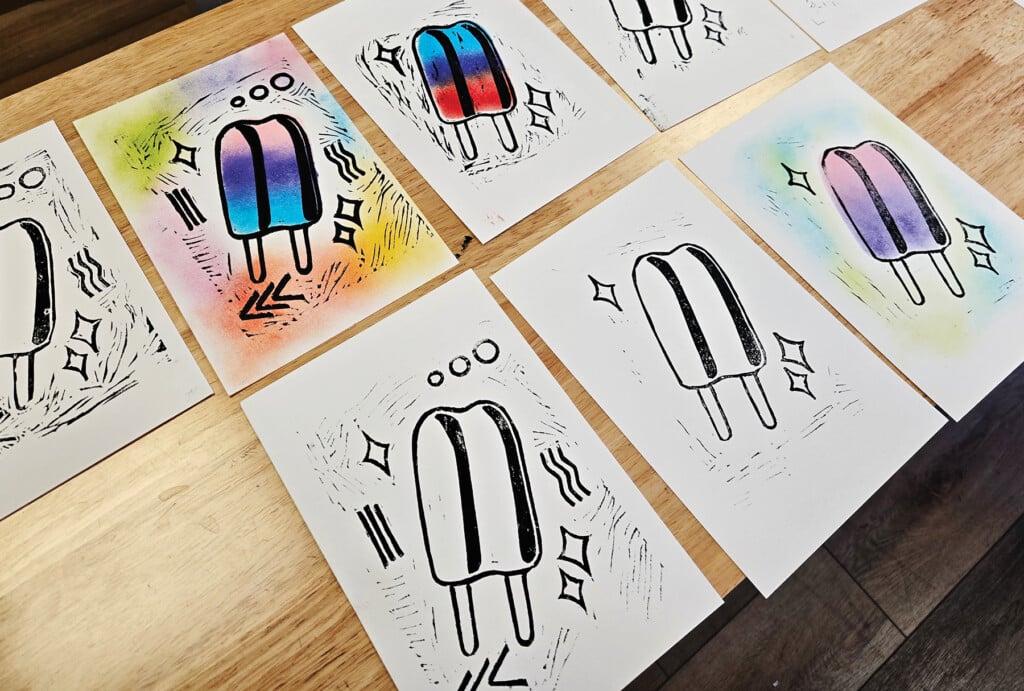
Now she incorporates those drawings directly into her ceramics. Using a screen-printing process adapted for clay, she transfers the images onto porcelain, then colors them in with underglaze chalks. The method intentionally echoes childhood methods of tracing, filling in, and working within the lines. “Immortalizing those drawings on ceramic has allowed me to kind of collaborate with my past,” she says.
It’s a direct way of working with memory, not just referencing it. “Memory is so fragile,” she notes, which makes the act of preserving it feel even more important. Clay, with its durability, becomes a way to hold onto something that might otherwise fade.
Heusohn splits her practice between a home setup and Tallahassee Clay Arts, a local ceramics collective and shared workspace, where she fires and glazes her work and is an instructor and studio technician. There, she works with a wide range of students, many of whom arrive unsure of their own creative capacity. “My job is to encourage them and help them find something that resonates,” she explains, creating space for exploration across ages, backgrounds, and skill levels.

Photos by Erich Martin
That same mindset shapes her own philosophy. She approaches making with a sense of flexibility, often scrapping pieces and starting over. “I like embracing failure,” she says, seeing it as part of the process.
Ceramics, she notes, is a kind of controlled chaos. Firing can shift colors, crack surfaces, or completely change a piece in unpredictable ways. For Heusohn, that isn’t frustrating; it’s essential. It echoes the same ideas her work is built around: Not everything can be controlled, and sometimes you have to let go of what you thought something would become.
In the end, her work connects with the viewer because it feels familiar. Though it’s rooted in her own experiences, it reflects a broader truth. Everyone carries memories. Everyone holds onto things, some visible, some not. Her vessels give that experience a physical form, making it easier to see and maybe easier to understand.
By turning those invisible, internal moments into something tangible, Heusohn’s work doesn’t just tell a story. It creates a space where others can recognize their own.