Welcome To The Neighborhood
Los Robles Celebrates 100 Years
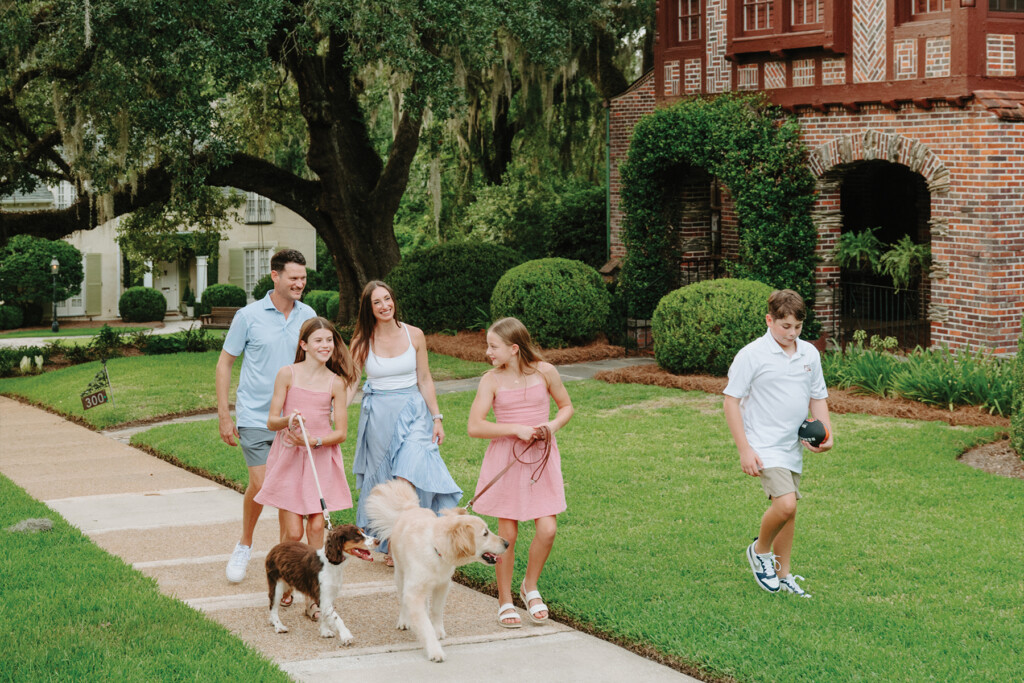
In 1926, two men looked out upon a 37-acre dairy farm on the outskirts of Tallahassee, then a town with few paved streets and just 10,000 inhabitants. Where others saw grazing cattle, however, they envisioned an elegant Mediterranean-themed subdivision with all the modern amenities of early twentieth-century life.
A century later, Los Robles is one of Tallahassee’s premier neighborhoods, a lasting tribute to the vision of Swedish-born civil engineer Leon Lonnbladh and his sales agent Albert Thornton. Inspired by South Florida, the two men marketed Los Robles as “Tallahassee’s Coral Gables.” Ads first appeared in the Tallahassee Daily Democrat in February 1926, selling 135 lots ranging in price from $1,200 to $4,000. Los Robles, which is Spanish for “the oaks,” was envisioned as a Mediterranean-themed suburb, and its streets still bear Spanish names like Cristobal Drive, Cortez Street, DeSoto Street, Fernando Drive, Isabel Court, and Ponce Street.

Photos by Alicia Osborne
A product of the era’s “Good Roads” movement, the neighborhood debuted with modern amenities like paved streets, sidewalks, electricity, and high-pressure gas and water mains. Originally, the developers stipulated that all exterior walls must be built with concrete, hollow tile, brick, or stone, and had a landscape gardener and architect on hand to consult with the new homeowners.
“As this plan is built, so will Los Robles be built; along orderly lines, masterfully built for immediate beauty and long substantial satisfaction,” one ad for the subdivision proudly proclaims.
However, the Florida Land Boom burst later that year, and only eight homes were completed by 1930. The neighborhood developed slowly, with homes built in a diversity of architectural styles, including Colonial Revival, English Cottage, Georgian Revival, Tudor, and Ranch. Today, just four of the neighborhood’s roughly 100 homes are Mediterranean revival style.

Photos by Alicia Osborne
The entrance to the neighborhood is marked by the iconic Los Robles gate in the heart of Midtown, the first structure Lonnbladh and Thornton built. The 26-foot-tall arch was damaged by a falling tree during Hurricane Kate in 1985, and by the early 2000s, the structure was so badly cracked that it was blocked off to traffic. A three-year, $150,000 restoration effort rebuilt the gate, and a neighborhood crest bearing an oak tree was reattached in 2016.
Next door, the Tallahassee Woman’s Club was built in 1927 and boasts its own illustrious history. It claims to be the oldest civic organization in town, contributing to countless local philanthropic efforts over the years and even temporarily turning its clubhouse over to the Red Cross to support the war effort during World War II. The Mediterranean revival-style clubhouse continues to host events.
“The clubhouse is the crown jewel of Midtown,” says former Woman’s Club President Sue Tully.

Photos by Alicia Osborne
The center of the subdivision, where a farmhouse built around 1890 once stood, was left undeveloped and became a neighborhood park. The farmhouse was relocated to 1639 Fernando Drive and was purchased by Merlin and Candy Mitchell in the 1980s—by then, the home was condemnable, leaning noticeably and leaking badly. An extensive restoration brought out the house’s original character, removing sheet rock to reveal wooden walls and ceilings made of old-growth heart pine.
During the restoration, the Mitchells discovered little artifacts left behind by each previous owner of the house: an old British farthing that likely belonged to the British sea captain built the home, the name of Louisa Donk—the little girl who lived in the home in the 1910s—scratched into a window pane, a 1928 issue of American Childhood magazine, and theater tickets for Boy Meets Girl purchased by the couple that bought the home in 1949. Those were some of the items on display when residents gathered at Los Robles Park in April for a centennial celebration where they showed off mementos and historic artifacts from their homes.
One of the first new homes built was the French eclectic Covington House at 328 Cortez Street. The home’s architect was William Edwards, who designed the Westcott Building, Dodd Hall, and several other structures on Florida State University’s campus. Built in 1926, the home on Cortez Street originally belonged to lumber and turpentine magnate Wade Hampton Covington.

Photos by Alicia Osborne
His wife, avid horticulturist Blanche Covington, was a founding member of the Tallahassee Garden Club—originally the Los Robles Garden Club. Quite ahead of her time, Blanche organized a public plant exchange in 1931 and converted her garage into a garden center where she hosted gardening workshops. She later led successful efforts to preserve the majestic oak trees that line Park Avenue in downtown Tallahassee, helped establish an arboretum in what today is Lafayette Park, and even has an orchid variety named in her honor.
Blanche died in 1958, but some longtime residents still remember trick-or-treating at Blanche Covington’s house. To earn their candy, children first had to spend some time minding their manners in her sitting room. The Covington House remains one of Los Robles’ greatest treasures, with massive square columns, a limestone fireplace, vaulted ceilings, and even a hidden Prohibition-era wine cellar. The front yard features a pair of sprawling live oaks believed to be 350 years old.
“It’s our favorite house in town, just a wonderful place to live,” says James Gustafson, who purchased the home in 2018.

Photos by Alicia Osborne
Down the street, the Tudor Revival-style Moor House has a twin in France. It was built in 1931 by Frederick Moor, a medical doctor who spent World War I stationed in a French chateau that had been converted into a hospital. Moor drew careful sketches of the home and built himself a copy when he returned to the States. During construction, he imported a 15-foot-tall mirror from Europe, which he discovered couldn’t fit through the door. Undeterred, Moor had the living room wall knocked down so the mirror could be brought inside.
Little about the home has changed in the last 95 years, from the vintage phone nook to the massive mirror that still adorns the living room wall. Today, Moor’s great-granddaughter, Sara Merrill, is the fourth generation of her family to live in the house. She visited often when it belonged to her grandmother and fondly remembers playing hide-and-seek in the home’s many closets.
“It’s got so much character,” says Merrill.

Photos by Alicia Osborne
Frederick Moor’s brother, local insurance man Frank Moor, built the home across the street. In 1940, he and his wife Beth hosted First Lady Eleanor Roosevelt. Beth and Senator Claude Pepper had arranged for Roosevelt to deliver a 45-minute speech at the Florida State College for Women, which drew overflow crowds.
One thing residents love about Los Robles is that it has always been a great place for kids to play. Longtime residents Earline Adkison and her cousin “Tutter” Montgomery were delivered by the neighborhood doctor, Dr. John Williams, on Fernando Drive. They remember a time when windows and doors were left unlocked and days were spent fishing at Lake Ella, buying produce from farmers on passing horse-drawn wagons, and visiting Mrs. Covington to admire her goldfish pond. During World War II, they would walk to Byrd’s Grocery to buy bubble gum with their ration books whenever a new shipment came in.
“Bubble gum was a rare treat,” recalls Adkison.
In those days, a friendly policeman named Sergeant Prater—affectionately called “Mr. Potater” by the neighborhood kids—helped children cross Thomasville Road, which was one lane each way.

Photos by Alicia Osborne
Byrd’s Grocery is now a Whataburger, and Thomasville Road is now four lanes, yet the neighborhood has retained the feel of a quiet suburb while still enjoying close proximity to the bustle of Midtown. Many of the homes have stayed in the family for several generations, and residents describe a tight-knit community slightly reminiscent of a bygone era, one where people were a little friendlier and more neighborly.
“There aren’t many helicopter parents in the neighborhood—there’s not much though-traffic, and the kids just sort of play,” says Ellen Berkowitz, who has lived in Los Robles with her husband, Jerry Altman, for 38 years. “It’s really a little oasis.”