Blooming Bravery
Fred and Doby Flowers keep up the fight for justice in their hometown
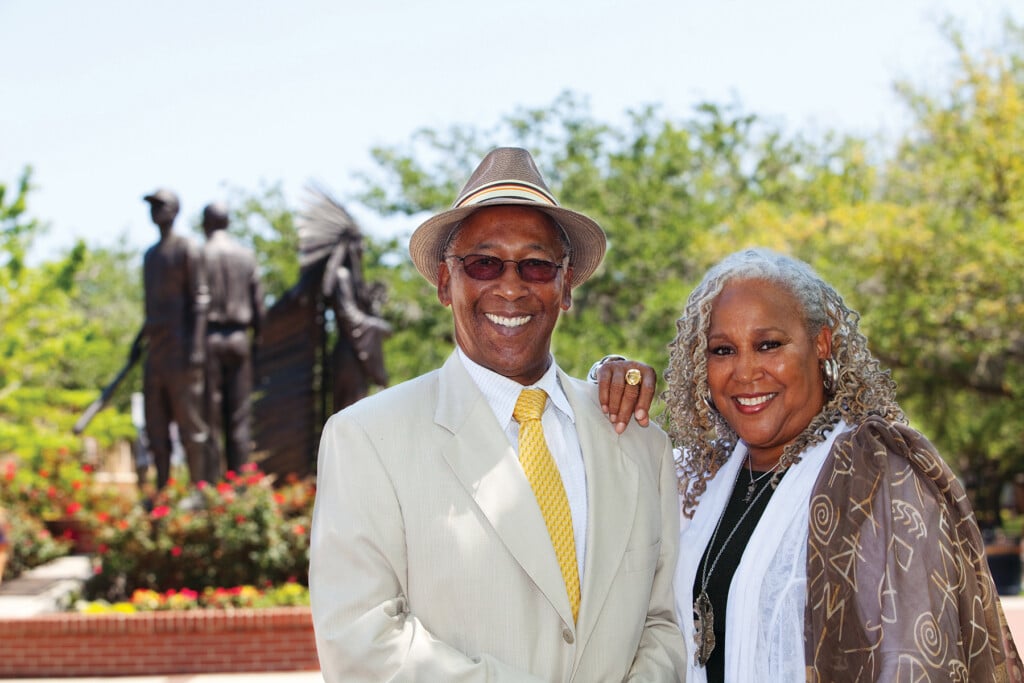
Fred and Doby Lee Flowers, Tallahassee natives, came from a long line of Florida A&M graduates who were committed to addressing the racial injustices prevalent in Tallahassee during the 1960s. Though they could have followed in their family’s footsteps and gone to a historically Black college and university (HBCU), both chose to integrate Florida State University (FSU)—and, in turn, make history.
Decades later, both still fight to empower and educate those seeking fairness and equality.
“[Growing up in Tallahassee] made me a person who cares about people,” Doby says. “It made me an advocate and a fighter. It made me an individual who can get along with others and who understands what’s right and wrong and how people should be treated. It made me a real activist in terms of my mindset.”
The same is true of her brother Fred, a Lincoln High School graduate, who in 1965 enrolled at FSU and became the school’s first Black athlete as a walk-on for the varsity baseball team. He was a pitcher (“not a hitter,” he says) who was switched to the outfield, where he endured taunts and racial epithets.
“I was angry, but I channeled that into becoming an activist for the people,” says Fred, who earned a philosophy degree in 1969.

Photos Courtesy of Florida State University Communications
Five years after Fred’s enrollment, his sister Doby, a Leon High School graduate, came to FSU as a social work student and that year became the school’s first Black homecoming queen. By then, she was one of 35 Black students at FSU, which boasted an enrollment of 18,000.
“When I won, it was not about being a beauty queen,” she says. “It was about breaking barriers. It was the last bastion that we had not broken through, and I remember the feeling of victory for all of the students, and I do mean all of them because they endorsed change.”
After graduation, Fred married and joined the military before returning to FSU to study urban and regional planning in 1973. After earning his master’s degree, he worked in Nashville, then returned to the Sunshine State to earn a law degree from the University of Florida. Civil rights has been the focus of his law practice for the past 45 years, he says.
Doby, meanwhile, also earned a master’s degree in urban and regional planning from FSU before leaving Tallahassee to work in city social services in Boston and New York. After taking a private sector job that brought her to Boca Raton, she decided she wanted something else. Fred told her money couldn’t buy happiness, and to quit her job and move home. Before she did, she bought a Greek Revival home in Thomasville, Georgia, that she thought she’d use as a retirement property.
“I spent a year restoring that house, and it was one of the best times I could remember,” Doby recalls. “Headhunters called me with job opportunities that I didn’t want. Up until this point, I’d had a life of jobs but not a life.”

Photos Courtesy of Florida State University Communications
That house is now the Magnolia Leaf Bed & Business, which Doby manages along with Fred’s law practice. Though Doby never married nor started a family of her own, she says she has no regrets. Besides, her five siblings have provided her with plenty of nieces and nephews to enjoy.
“I am blessed and highly favored,” she declares. “I have no complaints and no envy of those who may have chosen a path different from mine.”
The siblings have come full circle, though Tallahassee is larger and more diverse than it was in their youth. Both are eager to put a stop to current laws that have stripped Black people of rights they fought for more than 50 years ago.
“This is not the first time this has happened in history,” Doby says. “It’s a new age of Reconstruction, and we will fight again. We are not going back.”
In 2004, FSU honored Fred, Doby, and its first black student, Maxwell Courtney, with the Integration Statue, which portrays the three of them standing in a circle facing outward, presumably against a world that would hold them back. In 2018, Fred and Doby created a Civil Rights Institute at their alma mater to educate students and Florida residents about past civil rights issues and their impact on the struggle today. Doby, who is passionate about the city’s cultural offerings, has been building a chapter of The Society, Inc., which exposes youth in underserved communities to the literary, performing, and visual arts.
“I’m glad to be in Tallahassee,” Fred says. “This is my part of the universe where I can do the best I can with what I have. And I still have a lot of work to do.”
Here’s to Fred and Doby’s decades of work, which have made an indelible impact on Tallahassee’s past, present, and future.
Feature image Photos Courtesy of Florida State University Communications